

"Tier 1" is on almost every page of this site, and on most of our competitors' pages too. It is rarely defined. Here is what we mean when we say it, and how to tell whether a rate deserves the label.
A Tier 1 FX rate is a top-of-book price: the best bid and the best ask competing for the most liquid flow, sourced from major banks and institutional pricing. It is not a Level 2 price sitting further from the market at low volume, and it is not one broker's quote.
Who are the Tier 1 contributors?
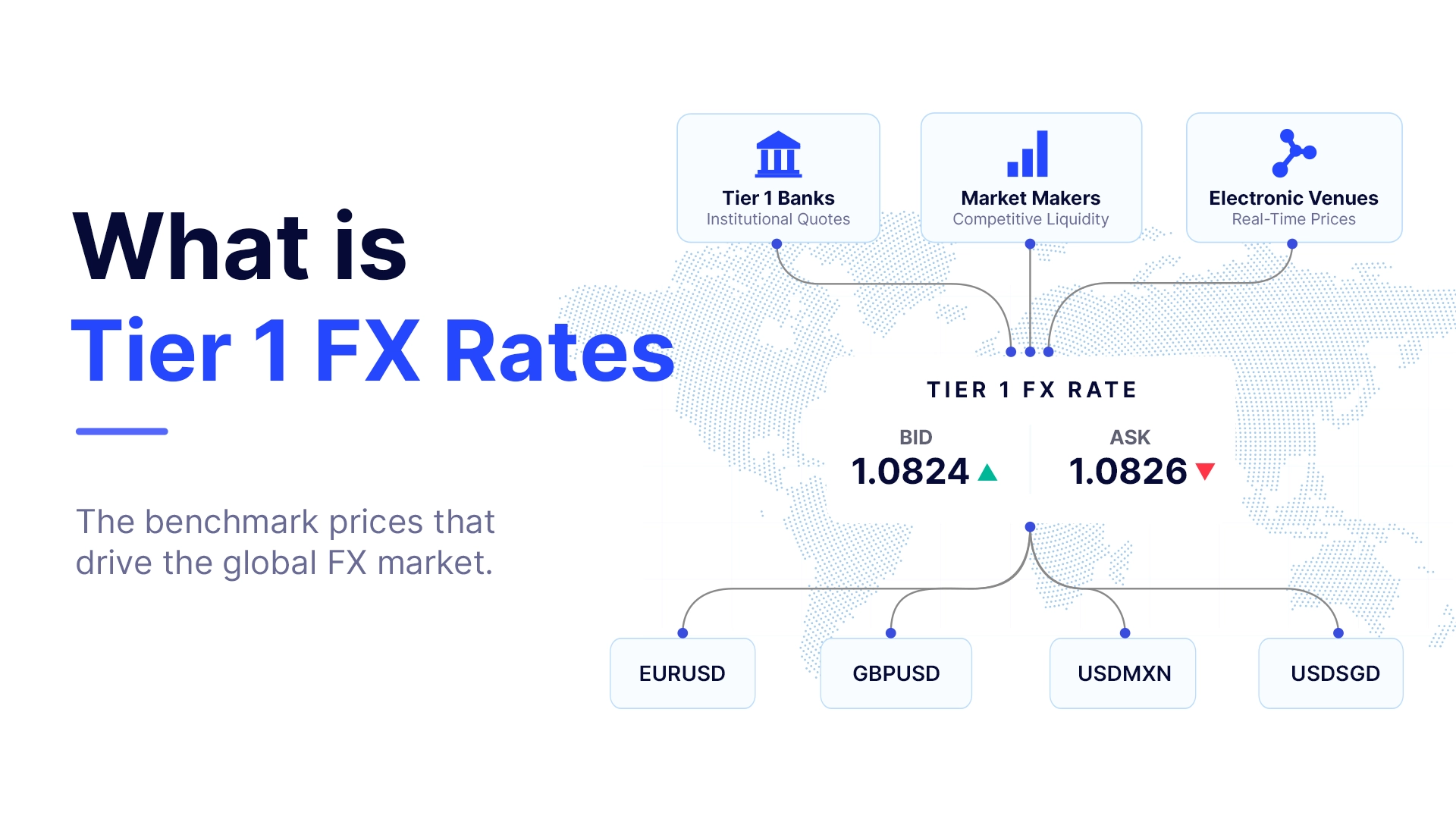
A rate is only as good as where it comes from. Our aggregated feed takes quotes from eight contributors across three kinds of source: Tier 1 banks, non-bank market makers, and electronic venues.
What matters more than the names is the mix. A bank quotes to its clients. A non-bank market maker quotes to win flow on venues. A venue shows the best of what its members are prepared to deal at. Put the three side by side and the tightest bid and ask across them is a fair picture of where the liquid market is. Take any one of them alone and you have that firm's view of the market, with that firm's spread on top.
That is the difference between a Tier 1 rate and the other things that get called an exchange rate:
| What you are given | What it actually is | When it is fine | When it is not |
|---|---|---|---|
| One broker's live quote | That broker's price, with their spread and their liquidity behind it | Trading with that broker | Pricing your own clients, checking another provider's rate |
| A traded price | The level at which one deal happened, some time ago | Charting after the fact | Quoting now; the market has moved since the trade |
| A rate scraped from a news or finance website | A delayed, often single-source mid with no bid or ask | A rough figure in an article | Anything a customer pays or a ledger records |
| An indicative rate | A price nobody is obliged to deal at | Context | Settlement, revaluation, margin calculations |
| A Tier 1 aggregated rate | Best bid and ask across banks, market makers and venues, refreshed continuously | Displayed prices, reference rates, revaluation | Nothing, provided the aggregation is done honestly |
The most common misunderstanding we hear from prospects is that "Tier 1" means the price at which the interbank market is trading, a wholesale rate you could deal on yourself. It is not. It is the best price being quoted at the top of the book. That is what you want as a reference, because it is where the liquid market is, but it is a quoted price, not a fill.
How is the displayed price formed?
The process is simple to describe and hard to do well.
- Collect. Quotes arrive from all contributors, continuously, through the trading week, each with a price and the size behind it. For the major pairs that is nine to ten updates a second, and up to 20 in busy periods.
- Screen. Anything that is not top of book is discarded. That means inverted rates, where the bid is above the ask, and locked rates, where bid and ask are equal. Out-of-market rates, where one contributor is quoting away from everyone else. Level 2 quotes, which are real prices but sit further from the market. And one-sided quotes, a bid with no ask or an ask with no bid. Size is part of the test: only quotes of one standard lot or more, 100,000 of the base currency, are considered. On EUR/USD the size behind the published price typically runs from 100,000 to 2.5 million or more. A tight bid and ask in small size is not the same market as one in millions, and it does not make it into the feed.
- Aggregate. From what survives, the feed publishes the tightest spread: the best bid and the best ask across contributors. This is a selection, not a blend. There is no time-weighting, no volume-weighting and no averaging across contributors; the published bid is one firm's bid and the published ask is one firm's ask. The mid is the average of those two prices. The size on each side is published with every quote on the streaming feed, and a depth ladder is available for platforms that need to see beyond the top of book, so you can judge for yourself how much market sits behind the price.
- Deliver. On WebSocket and FIX, which push every update to you, a new price arrives in under 50 milliseconds, measured to a client in a London data centre. REST is request and response: you receive the latest published price at the moment you ask, so its freshness depends on how often you ask, your connection and the size of the payload you request.
The screening never switches off. It runs through the Friday close, the Sunday open and every central bank announcement in between, because those are the moments a single bad contributor quote would otherwise become your day's high, your day's low, or a spread your clients can see. Our note on good quality tick data goes through the kinds of bad print in more detail.
Why does it matter to the price you show?
If you run a trading platform, a rate that is not top of book is a rate somebody can trade against. Suppose you quote EUR/USD to your clients at around 1.17480 while the liquid market is at 1.17500. A client on a faster feed sees the gap and buys €1 million from you at 1.17487. The market is already 1.17502. You are 1.5 pips, or about $150, underwater on that ticket before you have hedged it. That is latency arbitrage, and it works because your reference price was not the market's. The figures are illustrative; the mechanism is not.
If you run a payments or remittance product, you rarely make the market, but you do buy from someone who does. A Tier 1 reference rate is how you check the rate your bank or FX provider gave you, price your corridors with confidence, and net positions knowing what the market actually was at the time.
If you sit in treasury, the reference rate is what turns a vague profitability question into two numbers. Execution cost is your reference rate against the rate you actually hedged at. Commercial margin is your treasury rate against the rate you charged the customer. With both in hand you can see whether weak margins come from liquidity, hedging, customer pricing or corridor costs. A treasurer should care more about reference-rate accuracy, executable depth, netting efficiency and settlement costs than about whether a vendor puts "Tier 1" on its website. The label is only worth what is behind it.
How do you check a vendor's claim?
Six questions, phrased so they apply to us as much as to anyone:
- How many contributors feed the rate, and what kinds of firm are they?
- Is the published price top of book at institutional size, and what is the minimum quote size that counts?
- What is rejected before a price is published, and does that screening run at the open and through events?
- Is the published bid and ask a straight selection of contributors' own prices, or a time-weighted or volume-weighted average, and how is the mid derived from them?
- Which figure is the latency claim: the engine, or delivery to me, and over which protocol?
- Can I see the feed's availability measured by someone other than the vendor?
On the last one, our uptime is measured by a third party and published live, and Beyond 99.9% uptime explains why the architecture behind that number matters more than the number.
A short glossary
Tier 1. Top-of-book pricing sourced from major banks and institutional market makers. Contributor. A bank, market maker or venue whose quotes feed an aggregated rate. Aggregation. Combining contributor quotes into one published bid and ask, after screening. Top of book. The best bid and best ask available at a given moment, in institutional size. Standard lot. 100,000 units of the base currency, the minimum size a quote must carry to be considered. Depth. The sizes available at prices beyond the top of book. Mid. The average of the top-of-book bid and ask. Locked market. A quote with bid equal to ask; discarded, like an inverted one, before selection. Indicative rate. A price shown for information that nobody is obliged to deal at.
TraderMade was founded in 1984, has worked alongside bank trading desks since the 1990s, and has sold FX rates by API since 2017. The feed described above is the one behind our FX Rates API; Exchange Data International distributes it to their own clients as a real-time and historical FX feed, and GTN, a global trading and wealth platform, runs on it in production (customer story).